How to Exchange Your Foreign Driving License for a Vietnamese Motorbike License in 2026: Process, Costs, and Common Pitfalls
Looking for a place in Vietnam? Tell us what you need and we’ll look for matching options.
Request a home searchHow to Exchange Your Foreign Driving License for a Vietnamese Motorbike License in 2026
If you're renting an apartment in Vietnam for a month or a year, a motorbike is often the easiest way to get around. Before you ride, make sure you have the right license. Here's how to exchange a valid foreign national driving license for a Vietnamese A1 or A motorbike license in 2026 — including eligibility, documents, costs, processing times, and common mistakes to avoid.
Vietnam updated its driving-license rules again on 1 July 2026, so some older online guides are now out of date. This one reflects the current process.
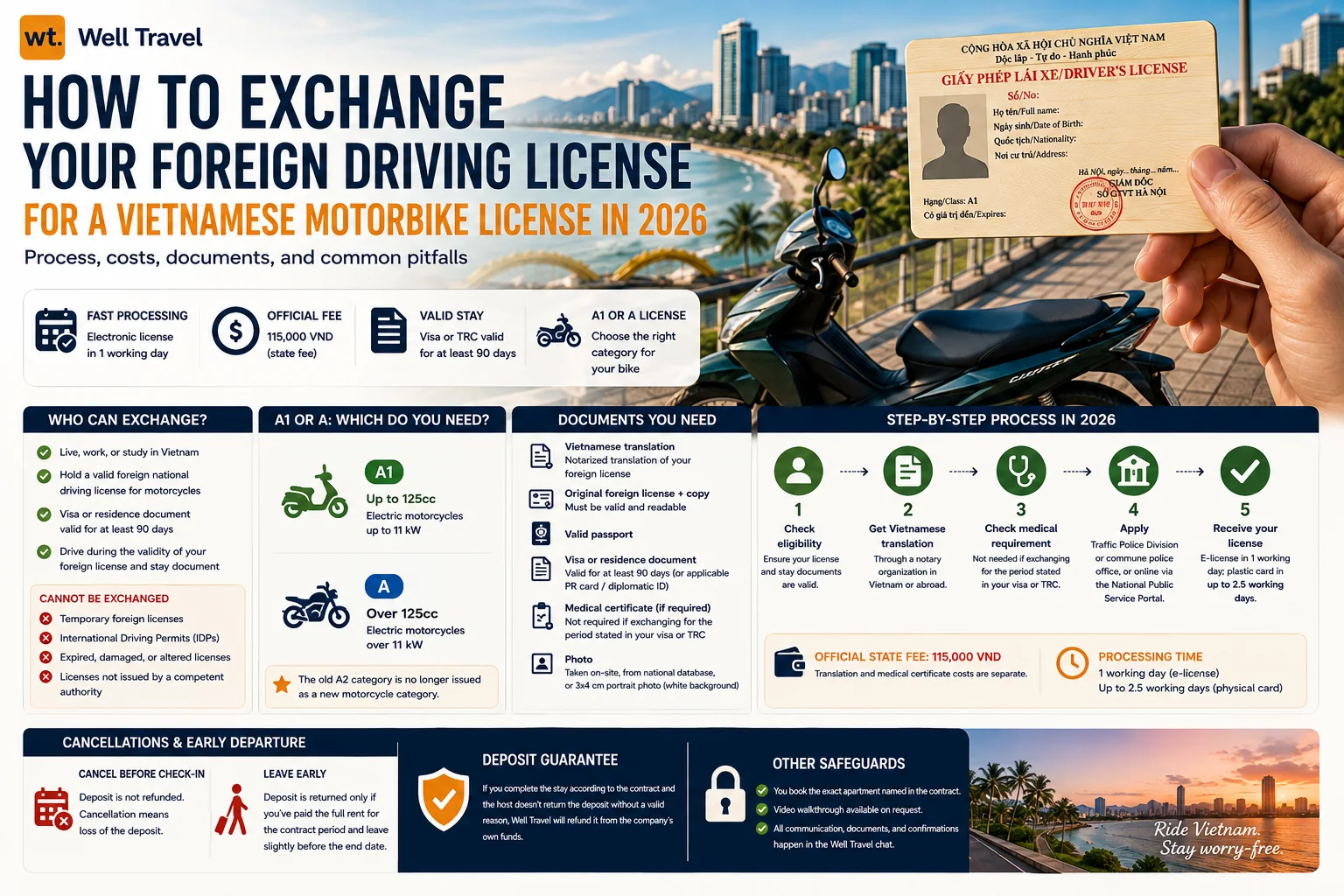
Quick Answer: Can You Exchange a Foreign License in Vietnam?
Yes, if you're a foreigner living, working, or studying in Vietnam and you hold a valid foreign national driving license that allows you to ride motorcycles. Your visa or residence document also needs to be valid for at least 90 days, or qualify under a permanent residence or diplomatic/service category.
The exchange applies to the foreign national license itself, not to an International Driving Permit (IDP).
From 1 July 2026, applications are handled by the Traffic Police Division (Phòng Cảnh sát giao thông) or a commune-level police office (Công an cấp xã) with a license-processing point. You can also apply online through the National Public Service Portal.
The official state fee is 115,000 VND. Translation and medical-certificate costs are separate. Once a complete application is accepted, the electronic license is issued within 1 working day; a physical plastic card is printed within up to 2.5 working days.
Who Can Exchange a Foreign License?
You're eligible if you:
- live, work, or study in Vietnam;
- hold a valid foreign national driving license;
- have an accepted proof of legal stay, such as a visa valid for at least 90 days, a temporary residence card valid for at least 90 days, a permanent residence card, or a diplomatic/service identity card;
- want to drive in Vietnam during the validity period of your foreign license and stay document.
The Vietnamese license you receive is tied to the shorter of your foreign license's validity, your visa/residence validity, and the maximum validity allowed for the Vietnamese category.
What cannot be exchanged
The following do not qualify:
- temporary foreign driving licenses;
- International Driving Permits (IDPs);
- expired foreign licenses;
- licenses that are altered, damaged, or missing identifying information;
- licenses not issued by a competent authority.
If the authorities have doubts about your entry, residence status, or how the foreign license was obtained, they may ask for additional verification.
A1 or A: Which Vietnamese Motorbike License Do You Need?
Under Vietnam's current system, the relevant motorcycle categories for foreigners are:
- A1 — motorcycles up to 125cc, and electric motorcycles up to 11 kW.
- A — motorcycles over 125cc, and electric motorcycles over 11 kW.
The old A2 category is no longer issued as a new motorcycle category. If you're planning to ride a 150cc or larger bike, you need category A, not A2.
Documents You Need
1. Vietnamese translation of your foreign license
Get a Vietnamese translation of your foreign national driving license. The translation must have its quality certified by a notary organization in Vietnam, or be prepared by a Vietnamese representative mission abroad. The translated document is attached to a copy of the foreign license.
2. Original foreign driving license and a copy
Your license must be valid, issued by a competent authority, readable, and a national license — not an IDP. Bring the original for verification and keep a copy for your records.
3. Valid passport
Foreign applicants need a valid passport.
4. Visa or residence document
Provide a visa valid for at least 90 days, a temporary residence card valid for at least 90 days, a permanent residence card, or diplomatic/service identification where applicable. The original must be shown for comparison if you're submitting a non-certified copy.
5. Medical certificate — but not always
A Vietnamese driver's health certificate is normally part of the exchange file. But if you're exchanging your license for the period stated in your entry visa or temporary residence card, you don't need one. Check this before paying for a medical exam.
6. Photo
For in-person applications, you can have your photo taken at the receiving point, use a photo from the national identity database, or bring a 3 × 4 cm portrait photo with a white background. If applying online, upload a portrait photo or use an available identity photo as instructed.
Step-by-Step: How to Exchange Your License in 2026
Step 1: Check your eligibility
Confirm your foreign license is still valid, includes motorcycle entitlement, and isn't temporary, expired, damaged beyond identification, or an IDP. Then check which Vietnamese category corresponds to your motorcycle entitlement.
Step 2: Get your Vietnamese translation
Have the license translated through an accredited notary organization in Vietnam or through the permitted Vietnamese representative service abroad. Bring both the original and translated copy when applying.
Step 3: Check the medical certificate requirement
If you're exchanging for the period stated in your visa or temporary residence card, no medical certificate is required. If the exception doesn't apply, get a driver's health certificate from a qualified medical facility in Vietnam.
Step 4: Submit your application
Apply in person at a Traffic Police Division or commune-level police office with a license-receiving point, or submit online through the National Public Service Portal. Bring originals for verification if applying in person.
The receiving authority enters your application into the electronic licensing system. If your application isn't eligible, they must explain why.
Step 5: Pay the official fee
The official government fee for issuing, exchanging, or reinstating a driving license is 115,000 VND. Translation, medical exams, photocopies, delivery, and other optional services cost extra.
Step 6: Wait for your license
Once a complete and valid application is received:
- the electronic Vietnamese license is issued within 1 working day;
- if you request a physical plastic card, it's printed and returned within up to 2.5 working days.
You can pick it up at the receiving authority or have it sent by post if requested.
How Much Does It Cost?
The only fixed government fee is 115,000 VND.
Total costs vary because you may also pay for:
- Vietnamese translation of your foreign license;
- a medical certificate, if the exemption doesn't apply;
- photocopies or other document services;
- postal delivery, if requested.
Translation and medical prices are set by individual providers, so there's no single official total. Treat figures like 600,000–1,500,000 VND as a personal budget estimate, not an official cost.
How Long Does It Take?
The official processing time starts only after your application is complete and accepted. The electronic license takes 1 working day; a physical plastic card takes up to 2.5 working days.
This doesn't include time to prepare the translation, get a medical certificate if required, make copies, or get to a receiving point. Older online estimates of 5–10 working days no longer reflect the official processing timeframe.
Common Mistakes to Avoid
- Using an IDP instead of your national license. The exchange applies to the foreign national driving license, not an International Driving Permit.
- Applying with an expired foreign license. Expired licenses are excluded. Check the expiry date before paying for translation or other paperwork.
- Assuming A1 covers every scooter. A1 covers up to 125cc. Anything over 125cc falls under category A.
- Trusting old A2 advice. A2 is no longer issued as a new category in the current system.
- Paying for a medical exam unnecessarily. Foreigners exchanging for the period stated in their visa or temporary residence card don't need a medical certificate.
- Bringing only photocopies. The authorities need to compare originals with copies for in-person applications.
- Getting the name wrong. Make sure the Vietnamese application and translation match your passport exactly.
- Expecting official processing time to include document prep. The clock starts after a complete application is accepted.
- Using unofficial license agents. The official process still requires a valid foreign national license and supporting documents. Paying an intermediary doesn't remove those requirements.
Final Checklist
Before you apply, make sure you have:
- a valid foreign national driving license with motorcycle entitlement;
- a valid passport;
- an eligible Vietnamese visa or residence document;
- a Vietnamese translation of your foreign license;
- a medical certificate only if the exemption doesn't cover you;
- copies of your documents;
- the 115,000 VND official exchange fee;
- access to a Traffic Police receiving point or the National Public Service Portal.
After receiving your Vietnamese license, check your full name, date of birth, license category, validity period, and whether the category matches the motorcycle you intend to ride.
The Bottom Line
For foreigners living in Vietnam, exchanging a valid foreign national driving license is usually much simpler than starting over in the Vietnamese licensing system. The rules changed on 1 July 2026, so use the current process: exchange your actual national license, prepare the Vietnamese translation, check your visa/residence eligibility, confirm the medical certificate exception, and apply through the official Traffic Police or National Public Service Portal.
Do that, and you'll be able to ride legally and confidently — with a license that actually covers the bike you're riding.