Long-Term Rentals in Thailand: Complete Guide (2026)
Looking for a place in Thailand? Tell us what you need and we’ll look for matching options.
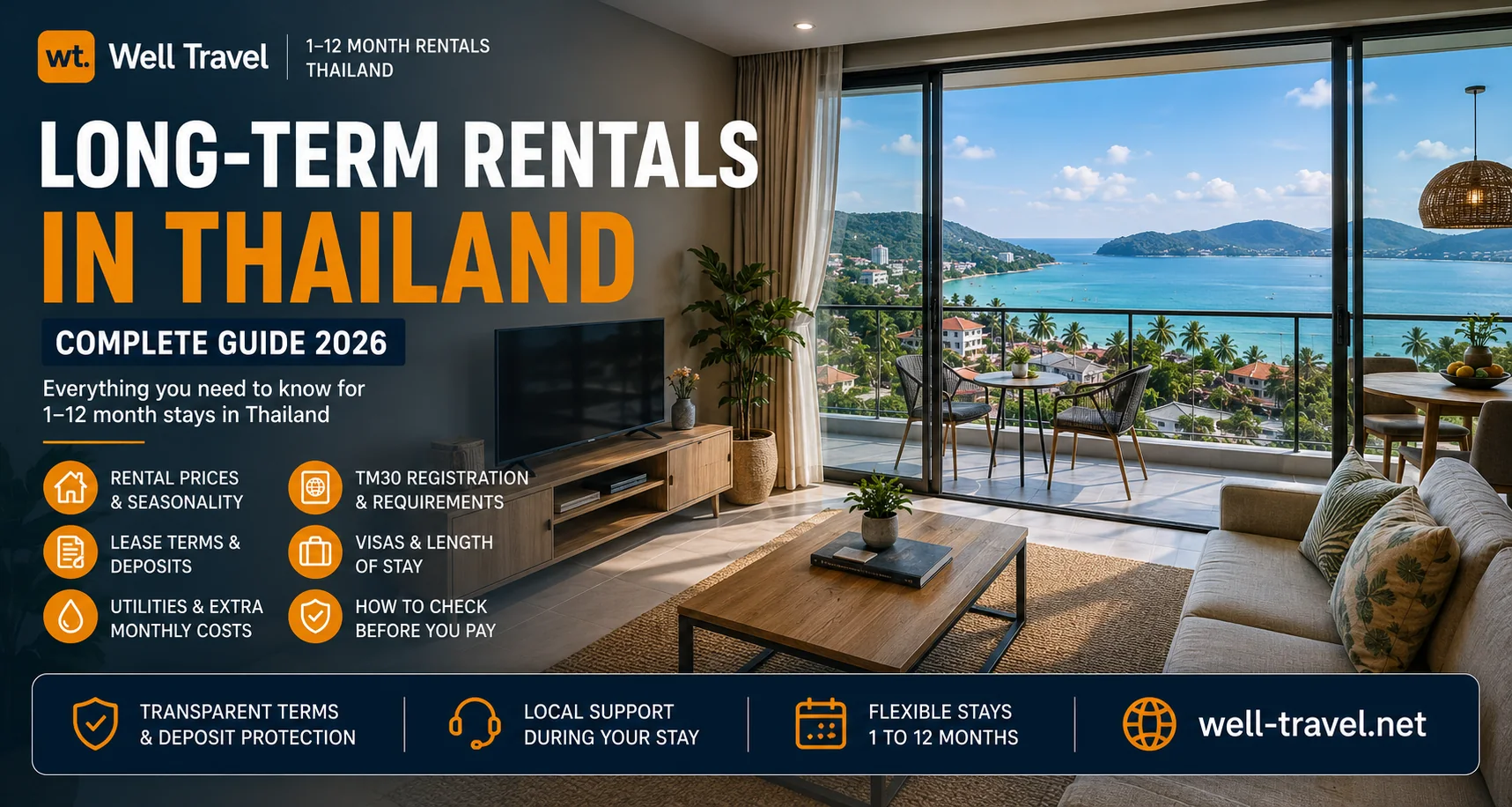
Request a home searchA practical 2026 guide to renting in Thailand for 1–12 months: typical rental prices, seasonality, lease terms, security deposits, utility costs, TM30, visas, and what to check before paying.
Planning to stay in Thailand for a month, a season, or a year? Long-term rentals are widely available, with furnished condos, apartments, houses, and villas in major cities and popular beach destinations.
But rental prices aren’t fixed. They vary depending on the season, location, demand, property condition, amenities, and length of stay — especially in tourist destinations such as Phuket, Koh Samui, and Krabi.
This guide explains what to expect when renting long-term in Thailand in 2026, from typical rental prices and deposits to utilities, contracts, visas, TM30 registration, and the checks worth making before you pay.
Quick Answer: What Most Long-Term Renters Need to Know
- Monthly and long-term rentals are widely available, but the minimum lease length depends on the property and landlord.
- A longer lease can sometimes mean a lower monthly rate, but there is no automatic 10–20% discount.
- Rental prices can change significantly with season, location, demand, and property type.
- Security deposit terms depend on the rental arrangement and, for certain rental businesses, applicable Thai consumer-protection rules.
- Electricity and water are often paid separately from rent. Internet may be included or charged separately.
- A landlord, householder, owner, possessor, or hotel manager accommodating a foreigner is generally responsible for submitting a TM30 notification within 24 hours of the foreigner's arrival at the residence.
- A rental contract does not extend your permitted stay in Thailand.
- Before paying, verify the exact property, rental terms, utility rates, deposit conditions, and the landlord’s right to rent out the property.
Types of Long-Term Rentals in Thailand
Thailand offers several common rental options. The right choice depends on your budget, preferred location, length of stay, and the facilities you need.
Condominium
Condos are one of the most popular choices for foreigners.
Depending on the building, facilities may include a swimming pool, gym, security, parking, and shared recreational areas.
Foreigners can rent condominium units in Thailand. Restrictions that often apply to foreigners when buying property and land do not prevent ordinary residential renting.
Serviced Apartment
Serviced apartments sit somewhere between a private apartment and a hotel. They may include reception, housekeeping, or other hotel-style services.
They can cost more than standard apartments but may offer more flexible rental periods.
Apartment
Standard apartments and walk-up buildings can be more affordable, especially if you don’t need resort-style facilities such as a pool or gym.
Quality, maintenance, and included services vary considerably from building to building.
House or Villa
Houses and villas offer more space, privacy, and often outdoor areas.
They can also come with higher utility costs, particularly when several air conditioners, large appliances, or a private pool are involved.
Rental Prices in Thailand in 2026
There is no single fixed rental price for any city or area. Monthly rent can vary depending on:
- season and tourist demand;
- location and neighbourhood;
- proximity to the beach;
- proximity to BTS or MRT in Bangkok;
- property age and condition;
- size and number of bedrooms;
- building facilities;
- lease length;
- the individual landlord.
Seasonality is particularly important in Phuket, Koh Samui, Krabi, and other tourist destinations.
The same property can have different prices at different times of the year. A monthly rate shown in an advertisement should therefore be treated as a price for a specific property and period, not as a permanent year-round tariff.
The figures below are rough market guidelines for furnished studios and one-bedroom units. They are not official city-wide averages or guaranteed prices.
| City / Area | Typical studio / 1-bedroom monthly range |
|---|---|
| Bangkok, central areas / near BTS and MRT | 15,000–40,000+ THB |
| Bangkok, areas farther from the centre | 10,000–18,000 THB |
| Chiang Mai, Nimman / Old City | 10,000–22,000 THB |
| Chiang Mai, outside the central areas | 7,000–12,000 THB |
| Phuket, popular beach areas | 15,000–40,000+ THB |
| Phuket Town and less touristy areas | 8,000–20,000 THB |
| Pattaya / Jomtien | 10,000–25,000 THB |
| Hua Hin | 10,000–25,000 THB |
| Koh Samui | 12,000–30,000+ THB |
| Krabi / Ao Nang | 10,000–22,000 THB |
These figures are intended only as a practical starting point.
Within the same city, prices can differ substantially. A new condo close to the beach with a pool, gym, and other facilities may cost several times more than a basic apartment in a less touristy area.
How Does Seasonality Affect Rental Prices?
Seasonality can have a major effect on rental prices in Thailand, especially in beach destinations such as Phuket, Koh Samui, and Krabi.
During periods of high demand, landlords may increase prices, prefer shorter bookings, or reduce availability for longer stays. During quieter periods, renters may have more options and more room to negotiate.
This means a price found for one month should not automatically be used as the expected price for another month.
When comparing properties, always check the exact rental dates.
Does a Longer Lease Cost Less?
Sometimes, but not always.
A 6- or 12-month lease may offer a lower monthly rate because the landlord receives a longer commitment. However, there is no universal 10–20% discount for long-term rentals.
Some landlords offer a lower monthly rate for a longer lease. Others keep the same price regardless of the rental period.
The safest approach is to compare the actual offers available for your dates rather than assuming a specific discount.
Security Deposit and Rental Terms
The security deposit is intended to protect the landlord against damage or other costs covered by the rental terms.
The amount, refund timing, and conditions for deductions depend on the rental arrangement and, where applicable, Thai consumer-protection rules.
For rental businesses covered by Thailand’s controlled residential rental rules, additional requirements apply. These rules include requirements concerning advance rent, security deposits, and utility charges. For covered rentals, the combined amount of advance rent and security deposit cannot exceed three months’ rent. Where no tenant-caused damage is found, the security deposit must be returned within seven days after the rental contract ends.
These rules do not mean that every private landlord in Thailand uses exactly the same rental arrangement.
Before paying, make sure you understand:
- the security deposit amount;
- when it will be returned;
- what circumstances can lead to a deduction;
- how utilities are calculated;
- what happens if the booking or rental is cancelled.
Security Deposit When Booking Through Well Travel
When you book a property through Well Travel, the security deposit is part of the booking and rental arrangement.
The deposit is non-refundable if the confirmed booking is cancelled, according to the applicable booking terms.
After the rental period ends, the security deposit is returned on the day of check-out or within 24 hours.
If there are valid grounds for a deduction under the applicable rental or booking terms — for example, confirmed damage or other outstanding obligations — the relevant amount may be withheld.
Well Travel also provides a deposit guarantee under its service terms. If a landlord keeps the security deposit without a valid contractual reason, Well Travel can cover the applicable refund to the client under the conditions of its deposit guarantee.
Before booking, always check the specific deposit, cancellation, and refund conditions that apply to your reservation.
What to Check in the Rental Contract
Before signing, make sure the contract clearly states:
- exact start and end dates;
- monthly rent;
- security deposit amount;
- conditions and timing for the deposit refund;
- early termination conditions;
- notice period for leaving;
- conditions for returning the property at the end of the rental period.
What to Clarify Before Signing
Not every practical rental condition necessarily appears as a separate clause in the contract. Before signing, also clarify with the landlord:
- how much electricity costs and how it is calculated;
- how much water costs;
- whether internet is included and, if not, how much it costs;
- who pays for shared building or common-area charges if they are not included in the rent;
- who is responsible for repairing the air conditioner;
- who is responsible for repairs to the water heater, appliances, and plumbing;
- whether pets are allowed;
- whether smoking is allowed;
- whether there are restrictions on guests;
- whether subletting is allowed.
If an important condition is discussed verbally, ask the landlord to confirm it in writing before you pay.
Utility Costs in Thailand
Utility costs vary depending on the property, consumption, and billing arrangement.
Electricity
Electricity is usually one of the largest additional expenses for renters, mainly because of air-conditioning.
A small one-bedroom apartment with moderate air-conditioning use may cost a few thousand baht per month in electricity. Heavy or continuous air-conditioning use can result in a substantially higher bill.
Thailand’s electricity tariffs depend on the applicable tariff structure and consumption. For rental businesses covered by the controlled-contract rules, electricity and water charges are subject to additional requirements, including limits tied to the rates charged by the relevant utility providers.
Before renting, ask exactly:
How much is electricity per kWh for this property?
Do not rely only on a general estimate. Actual costs depend on both your consumption and the property’s billing arrangement.
Water
Water is generally much cheaper than electricity, but the billing method varies.
Some properties use a meter, while others charge a fixed amount.
Always ask how water is calculated before signing.
Internet
Internet may be included in the rent or charged separately.
If it is not included, the price depends on the provider, connection type, and internet speed.
How Much Should You Budget for Utilities?
There is no single reliable utility figure for every apartment.
For a small apartment, budgeting a few thousand baht per month in addition to rent is a reasonable starting point, but actual costs can be significantly lower or higher.
Air-conditioning is usually the biggest variable.
Visa and Long-Term Rentals in Thailand
A rental contract does not give you the right to stay in Thailand beyond your permitted immigration period.
Your permitted stay depends on your nationality, visa or visa-exemption status, entry conditions, and the rules in force at the time of entry.
Important Visa Changes in 2026
Thailand’s visa-exemption rules are under revision in 2026, so older articles may contain outdated information.
On 19 May 2026, Thailand’s Cabinet approved changes that would revoke the 60-day visa-exemption scheme for all 93 countries and territories and introduce a revised structure, including shorter visa-exemption periods for certain travellers. The Ministry of Foreign Affairs stated that the relevant measures would take effect 15 days after publication of the corresponding Ministry of Interior announcements in the Royal Gazette.
Because the implementation status can change, do not rely on older information stating that all eligible nationalities automatically receive 60 days visa-free.
The applicable period depends on your nationality, the rules in force on the date of entry, and any applicable bilateral agreements.
If you are planning to rent a property for several months, check your immigration status and the current entry rules before committing to rental dates.
Destination Thailand Visa (DTV)
Thailand’s Destination Thailand Visa (DTV) is available to certain foreign nationals, including digital nomads, remote workers, freelancers, and people participating in eligible Thai cultural or other qualifying activities.
The DTV is a multiple-entry visa with five-year validity and allows a stay of up to 180 days per entry. A one-time extension of up to another 180 days may be available through Thai Immigration, subject to the applicable rules.
The visa is not automatically available to everyone. Applicants must meet the requirements of the relevant DTV category and provide the required supporting documents.
What Is TM30?
TM30 is a notification of a foreigner’s place of residence in Thailand.
Under Section 38 of the Immigration Act, the householder, owner, possessor, or hotel manager providing accommodation to a foreign national must notify the immigration authorities within 24 hours of the foreigner taking up residence.
TM30 is not a visa and not a tax.
After moving into a rental property, it is worth confirming that the TM30 notification has been submitted and keeping the confirmation for your records. It may be useful for later dealings with Thai Immigration or as proof of residence.
Choosing the Right City for Your Rental
There is no single best place to live in Thailand. The right choice depends on your budget, work, lifestyle, transport needs, and preferred environment.
Bangkok
Best for renters who want extensive public transport, BTS and MRT access, international medical facilities, shopping centres, restaurants, and a wide range of services.
Central areas and locations close to major transport lines usually cost more.
Chiang Mai
Popular with remote workers because of its relatively affordable rental market, relaxed lifestyle, cafés, and established digital-nomad community.
However, air quality can deteriorate significantly during the annual burning and smoke season, so this is worth considering before committing to a long stay.
Phuket
A good choice if you want beaches combined with a large selection of restaurants, gyms, international services, and tourist infrastructure.
Popular beach areas are generally more expensive, while Phuket Town and some inland areas can offer more affordable options.
Seasonality is particularly important in Phuket, so the price for one month may be very different from the price for another period of the year.
Pattaya
Pattaya offers a large selection of condos, extensive infrastructure, and a large international community.
Many areas offer more affordable rentals than the most popular beach locations in Phuket.
Hua Hin
A quieter coastal destination with established infrastructure.
It can suit renters who want a seaside lifestyle without the intensity of a major tourist centre.
Koh Samui and Krabi
Good choices for people who prioritise beaches and nature.
The long-term rental market is smaller than in major cities, and prices can be particularly sensitive to seasonality.
Khon Kaen, Udon Thani, and Chiang Rai
These cities can offer lower rental and living costs than Thailand’s major tourist destinations.
They are better suited to people who do not need to live near the beach or in a highly tourist-oriented environment.
How to Check a Rental Before Paying
Before transferring money, it is worth taking a few basic precautions:
- Ask for a live video tour of the exact unit you will rent.
- Test the air conditioner.
- Check hot water and water pressure.
- Test appliances.
- Check the internet connection.
- Check doors and locks.
- Ask about building rules.
- Ask whether there is nearby construction or planned renovation work.
- Clarify rules regarding pets, smoking, and guests.
- Take photos and videos of the property when you move in.
- Record the condition of furniture and appliances.
- Keep the photos until after the rental ends.
You should also verify who is renting out the property and whether that person has the right to enter into the rental arrangement.
Do not transfer a deposit based solely on listing photos or a conversation in a messaging app.
Before paying, make sure you know:
- exactly which property you are renting;
- who is renting it to you;
- the rental period;
- the total rent;
- the security deposit;
- how utilities are calculated;
- when and how the deposit will be returned;
- what happens if the booking or rental is cancelled.
Renting Directly or Through a Rental Service
Long-term rentals in Thailand can be found through:
- property websites;
- local agents;
- direct landlord listings;
- Facebook groups;
- specialised long-term rental services.
Each option has its own advantages and risks.
Finding a property independently can sometimes result in a lower price, but the renter is responsible for checking the property, landlord, contract, payment terms, and deposit conditions.
A local agent can help with property selection and negotiations, but fees and service conditions vary.
A specialised rental service can handle property selection, communication with the landlord, booking, contracts, and support during the rental period.
Well Travel specialises in long-term rentals from one month and helps clients find and book accommodation while providing support throughout the rental process.
Final Checklist for Renting in Thailand in 2026
- [ ] Calculate your total budget, including utilities.
- [ ] Check the price specifically for your rental dates.
- [ ] Take seasonality into account, especially in beach destinations.
- [ ] Choose an area that fits your actual lifestyle.
- [ ] Check the current immigration rules for your nationality.
- [ ] Make sure your rental period is compatible with your permitted stay.
- [ ] Read the rental contract carefully before paying.
- [ ] Confirm the security deposit amount and refund conditions.
- [ ] Ask the landlord about electricity and water rates.
- [ ] Clarify internet, maintenance, pets, smoking, guests, and subletting.
- [ ] Verify who has the right to rent out the property.
- [ ] Keep confirmation of your booking and payment.
- [ ] Take photos and videos of the property when you move in.
- [ ] Confirm that the TM30 notification has been submitted.
- [ ] Keep the contract, payment records, and important correspondence.
Final Thoughts
Long-term renting can be one of the easiest ways to live in Thailand for a month, a season, or a year without buying property.
But rental prices are not fixed. They can change significantly depending on the season, location, demand, property, and landlord. This is particularly important in popular destinations such as Phuket, Koh Samui, and Krabi.
When comparing properties, look beyond the advertised monthly rent. Consider the security deposit, electricity, water, internet, and any other additional costs.
Also check your immigration status before committing to a long rental period. Thailand’s visa-exemption rules are being revised in 2026, so information from older guides may no longer be reliable. Always check the rules applicable to your nationality and intended date of entry before finalising your rental dates.
Finally, after moving into your rental, make sure the required TM30 notification has been submitted within the applicable time limit and keep the confirmation for your records.