Mui Ne Kitesurfing Guide: Wind Season, Best Spots, Lessons, and Safety
Looking for a place in Mui Ne, Vietnam? Tell us what you need and we’ll look for matching options.
Request a home searchPlan a kitesurfing trip to Mui Ne with this practical guide. We cover the strongest wind months, water and beach conditions, launch spots for beginners and experienced riders, 2026 lesson and equipment costs, and key safety points to know before you get on the water.
Mui Ne is Vietnam’s best-known kitesurfing destination. Its long sandy coastline, warm water, established kite schools, and reliable seasonal winds make it one of Southeast Asia’s most popular places to learn and ride. The short answer: come during the main wind season from November to April, choose a launch area suited to your level, and take professional instruction if you’re new.
When Is the Kitesurfing Season in Mui Ne?
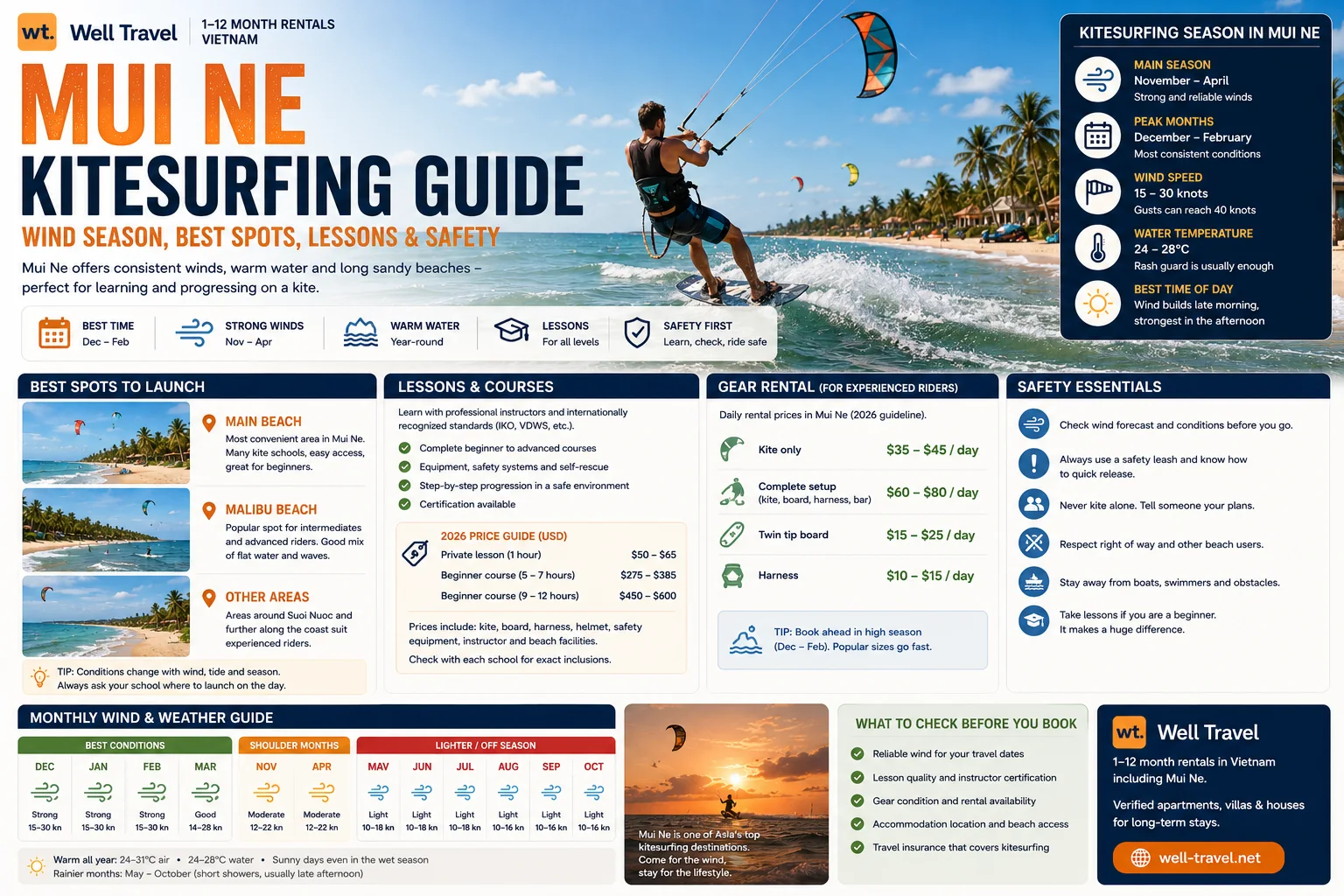
Mui Ne’s main kitesurfing season is driven by the northeast monsoon and runs from roughly November through April. The most reliable conditions usually appear from December to February, while November and March–April are shoulder months with more variable or moderate wind.
During the core season, wind speeds are often around 15–30 knots, though individual days can be stronger or lighter. Some local sources report gusts reaching around 40 knots in strong conditions, so beginners shouldn’t assume every windy day is suitable for their skill level.
For a 2026–2027 trip, December 2026 through February 2027 is the strongest overall choice if reliable wind is your priority. March can also be excellent, with slightly softer conditions than the winter peak. November and April can work well for beginners who prefer less intense conditions. From May to October, wind gets weaker and less predictable. Some schools still operate and experienced riders may find rideable days, but this is not the main season for a dedicated kitesurfing trip.
Wind and Water Conditions
Mui Ne stays warm year-round. During the main kitesurfing season, daytime air temperatures are generally in the high 20s to low 30s °C, and the sea stays warm enough that most riders use a rash guard rather than a full wetsuit. Water temperatures typically range from 24–28°C, depending on the month.
The wind follows a useful daily pattern. Mornings are often lighter, with the wind building toward midday and becoming stronger and more consistent in the afternoon. That gives beginners a calmer learning window, while experienced riders often prefer the afternoon conditions.
During the northeast monsoon, the main beach generally gets a cross-onshore wind. Expect a chop-to-wave environment depending on wind strength, tide, and location. This is not a flat-water lagoon destination, so first-time riders should learn with an instructor who knows the local conditions.
Best Areas to Launch
Kitesurfing activity is concentrated along the long beach strip around Mui Ne, with schools and launch areas spread across several kilometers.
Main Beach
The main beach around the Ham Tien/Mui Ne strip is the most convenient area for beginners and visitors staying in town. Multiple schools operate along this stretch, so you can easily combine accommodation, lessons, equipment rental, and beach access. If you’re learning, launch where your school recommends for that day’s conditions. They account for wind strength, waves, other riders, swimmers, boats, and available beach space.
Malibu Beach
Malibu is another established kitesurfing area used by local schools and experienced riders. It combines shallow water near shore with wave conditions further out, though the exact conditions change with wind and tide. It can be a good choice for riders with basic kite control who want to progress beyond beginner exercises.
Other Areas
Experienced riders may also explore other parts of the Mui Ne coastline, including areas around Suoi Nuoc. Conditions and accessibility vary, so ask a local school or experienced rider about the right launch point instead of choosing a spot based only on a map.
For beginners, the simplest rule is: launch where a reputable school recommends for that day.
Lessons, Certification, and Gear
Mui Ne has a well-established kitesurfing school scene, with instruction available for complete beginners through advanced riders. A structured multi-hour course is a much better option than a single introductory session if you’ve never kitesurfed before.
Beginner courses generally cover:
- Basic wind and weather assessment
- Kite setup and equipment checks
- Safety systems and quick-release procedures
- Kite control
- Launching and landing
- Body dragging
- Water starts
- Riding fundamentals
- Self-rescue
Several Mui Ne schools use certified instructors and international teaching standards. For example, C2Sky Kitecenter is an IKO center that offers beginner and advanced courses.
How Much Do Kitesurfing Lessons Cost in Mui Ne?
Prices vary by school, instructor, course length, and whether the lesson is private or shared. As a 2026 guideline, expect approximately:
- Private lesson: around US$50–65 per hour
- 5–7 hour beginner course: roughly US$275–385
- 9–12 hour beginner course: roughly US$450–600
Current school prices include US$50 for a one-hour private beginner lesson and US$550 for a 12-hour beginner course at Mr Khanh Kite School. C2Sky lists beginner packages ranging from US$385 to US$600. Other current price lists fall within a similar range.
Always check what the quoted price includes. Lessons may include kite, board, harness, helmet, safety equipment, instructor support, and beach facilities.
Renting Kitesurfing Equipment
If you already know how to ride, several schools and kite centers offer equipment rental. A complete setup may include kite, board, bar, harness, and safety equipment. Schools may ask about your experience or require a skills check before letting you rent independently.
Current local prices include complete-set rental from around US$40 per hour at one Malibu-based school, while other current 2026 guides put weekly complete-kite rental at roughly US$440–480. Exact prices depend on the equipment, rental period, and rider level.
If you bring your own equipment, ask about storage, washing, drying areas, and beach access before booking accommodation.
Safety Tips for Kitesurfing in Mui Ne
Kitesurfing is an action sport, and Mui Ne’s seasonal wind can become challenging quickly. Professional instruction is strongly recommended for beginners.
Before every session:
- Check your quick-release system and safety leash.
- Inspect your kite, lines, bar, and other equipment.
- Check the wind, waves, tide, and launch area.
- Keep clear of swimmers, boats, fishing gear, and other riders.
- Use a helmet and impact vest, especially when learning or riding in stronger conditions.
- Choose a kite size appropriate for the current wind and your experience.
- Know how to perform a self-rescue before riding independently.
- Follow local right-of-way rules and instructions from your school.
Do not launch just because other people are on the water. Wind strength and gusts can change quickly, and conditions that are manageable for an experienced rider may be unsafe for a beginner. Your school is also a good source of local information about the safest launch area, tide, wind direction, and current beach conditions.
Emergency Numbers in Vietnam
Vietnam introduced a national 112 emergency hotline in August 2025. It operates nationwide for incidents, disasters, accidents, and requests for emergency assistance. The existing numbers remain: 113 for police, 114 for fire and rescue, and 115 for medical emergencies.
For kitesurfing accidents, contact your school immediately if possible. Local instructors and beach staff can often coordinate help faster because they know the area and local emergency procedures.
Getting to Mui Ne
Mui Ne does not currently have a regular commercial passenger airport, so most international visitors arrive through Ho Chi Minh City and continue by road.
Mui Ne is roughly 200 km from Ho Chi Minh City. A private car takes around 2.5–3.5 hours in favorable traffic, while buses and shared transfers commonly take 4–5 hours. Cam Ranh International Airport (CXR) near Nha Trang is another option, but the transfer to Mui Ne takes several hours. For most international travelers, Ho Chi Minh City is the more straightforward arrival point.
Where to Stay for a Kitesurfing Trip
If kitesurfing is the main reason for your trip, staying close to the beach makes a big difference. The most convenient areas are along the main coastal strip, where many kite schools, restaurants, shops, and accommodation options are concentrated.
When choosing a place to stay, check:
- Distance to your kite school
- Secure equipment storage
- A place to rinse and dry gear
- Easy beach access
- Reliable Wi-Fi if you are working remotely
- Air conditioning
- Parking if you are renting a motorbike
If you bring your own kite and board, ask the property or school about storage before booking. Some kite centers provide lockers, shaded equipment areas, showers, compressors, and other facilities.
Bottom Line
Mui Ne remains one of Vietnam’s most established kitesurfing destinations, with a long sandy coastline, warm water, mature school infrastructure, and a strong seasonal wind pattern.
The main kitesurfing season runs from November to April, with the most reliable conditions generally from December to February. March can also be a great choice, while November and April offer more moderate shoulder-season conditions.
If you are a beginner, take professional lessons and follow the launch and safety guidance of a reputable local school. If you already ride, check the daily forecast and local conditions before choosing your launch area.
For a longer stay, choosing accommodation within easy reach of your preferred kite school makes the whole experience much easier, especially if you plan to ride regularly rather than just for a few days.