7 Red Flags a Southeast Asian Rental Listing Is a Scam (And How to Verify an Apartment Before You Pay)
Looking for a place in Indonesia? Tell us what you need and we’ll look for matching options.
Request a home searchLooking for a 1–12 month rental in Vietnam, Thailand, or Indonesia? The search is exciting—but it also attracts scammers. Fake rental listings across Southeast Asia usually follow the same script: beautiful photos, a surprisingly low price, and a request to send a deposit before you’ve verified anything.
The short answer: Before you pay, verify that the listing has a verifiable contract with the exact address and the landlord’s ID details, a video tour, clear booking and deposit return terms, and a protected payment method. If the host pressures you to pay fast, moves you to WhatsApp, or asks for money to a personal account, treat it as a scam.
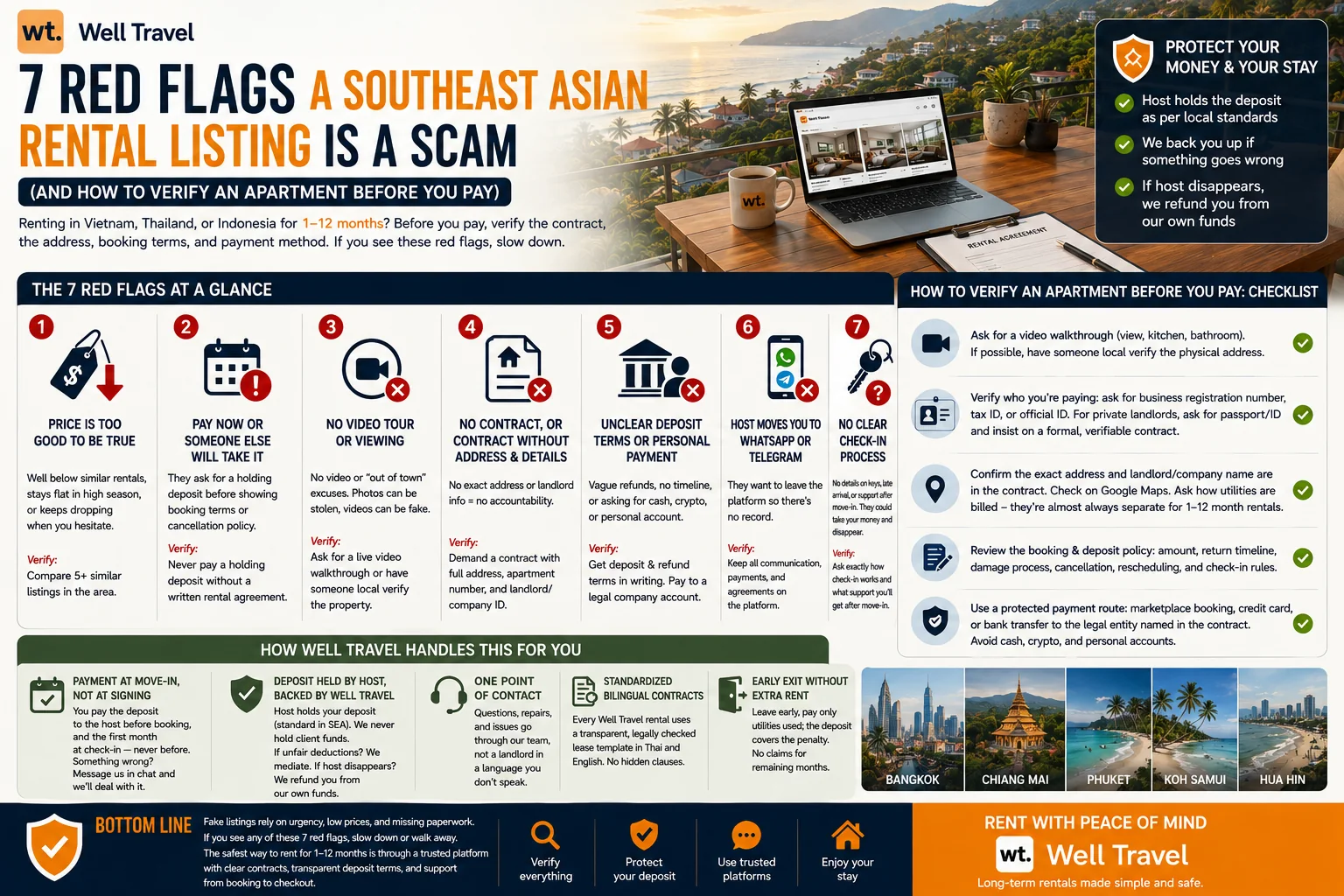
The 7 red flags at a glance
- A price that’s well below similar rentals, stays flat in high season, or keeps dropping when you hesitate.
- A demand for a holding deposit before you’ve seen booking terms.
- No video tour or in-person viewing.
- No rental agreement, or a contract without the exact address and landlord details.
- Vague deposit or refund terms, or payment to a personal account.
- Communication moves off the platform before the contract is signed.
- No clear check-in process or point of contact.
Let’s walk through each red flag and explain how to verify before spending money.
Red flag 1: Price is too good to be true
Southeast Asia has plenty of affordable rentals, but scam listings stand out even among cheap options. If a two-bedroom Canggu apartment with a pool, or a seafront Phuket studio, is listed at 30% below comparable places, ask why. Scammers set low prices because they want urgency, not questions.
Another common pattern: the price never changes in high season, or an extra discount appears the moment you hesitate. Real prices move with demand; scam prices just keep dropping.
- How to verify: Compare at least five similar listings in the same building or neighborhood. If the price is far outside the range — or keeps falling for no reason — assume it’s fake.
Red flag 2: Pay now or someone else will take it
Fake hosts create urgency. They’ll ask for a holding deposit via bank transfer or e-wallet to “reserve” the apartment, but won’t show you a contract or cancellation policy first. A legitimate host or marketplace lets you read the terms, confirm the details, and take a moment.
- How to verify: Never pay a holding deposit without a written rental agreement, exact address, defined cancellation policy, and clear booking process. A legitimate payment process gives you time.
Red flag 3: No video tour or viewing
Stolen photos are the easiest way to build a fake listing. A video tour is the cheapest way to expose it. If the host is “out of town” or says “no video available,” you’re likely talking to someone who isn’t at the property. Even a convincing video isn’t enough: scammers can keep the illusion going until you arrive and the apartment doesn’t exist.
- How to verify: Ask for a video walkthrough that shows the window view, the kitchen, and the bathroom. If the host refuses or keeps stalling, walk away. If you can, have someone local confirm the property exists before you pay.
Red flag 4: No contract, or a contract without the exact address and landlord details
A proper 1–12 month rental in Vietnam, Thailand, or Indonesia should come with a rental agreement. It should include the full property address, apartment number, owner or company name, rent, deposit, and the landlord’s official ID details. Without an address, you’re buying an unknown promise. Without the owner’s details, you have no one to hold accountable.
Private landlords sometimes skip contracts. That’s a big risk when money is moving upfront. On Well Travel, the exact address is in the contract, and host and company details are verified before listing. The contract is electronic, in the local language and English, so both sides can sign digitally. If a host says “we’ll send the address later” or “contracts aren’t necessary,” that’s a red flag. For more detail, read our guide to lease clauses every foreigner should check.
- How to verify: Demand a contract with the building name, street, city, apartment number, and landlord or company ID details. Check that address on Google Maps and look at street view. Ask how electricity, water, and internet are billed — for a 1–12 month rental, they’re almost always separate.
Red flag 5: Deposit terms are unclear or payment goes to a personal account
Security deposits are normal. Vague ones aren’t. You need to know exactly how much you’re paying, what the deposit covers, when it’s returned, and how damage is documented. Booking terms should be just as clear: cancellation, rescheduling, and late arrival rules must be set before you pay. If the host asks for cash, crypto, or a transfer to a personal account, there’s no protection.
With Well Travel, the deposit is returned on check-out or within 24 hours. If a host doesn’t refund the deposit without a valid reason, Well Travel’s deposit guarantee returns your money from company funds. If you cancel, the deposit isn’t returned — that protects the host too. You can read the full process in How Well Travel’s Deposit Return Guarantee works.
- How to verify: Ask for the deposit, refund, and booking terms in writing before paying. Use a payment method that creates a record — like a card or bank transfer to a legal company account — not a personal account.
Red flag 6: The host moves you to WhatsApp or Telegram
Scammers want to leave the marketplace because off-platform conversations leave no record. If a host asks to switch to WhatsApp or Telegram before a contract is signed, treat it as suspicious. On Well Travel, all communication stays in the Well Travel chat, so you have a complete history if something goes wrong.
- How to verify: Keep all conversations, payments, and agreements on the platform where your contract and deposit guarantee live.
Red flag 7: No clear check-in process
What happens on move-in day? Who hands over the keys? What if your flight is delayed? Scammers often collect money and disappear before check-in. A legitimate host or marketplace has a simple, clear process.
On Well Travel, detailed check-in instructions are sent in the chat on move-in day, and support continues after move-in — so a broken air conditioner or other issue doesn’t leave you stranded. If a host turns out to be dishonest, Well Travel’s deposit guarantee has your back.
- How to verify: Before you pay, ask exactly how check-in works and what support you get after move-in. If they can’t give specifics, that’s a red flag.
How to verify an apartment before you pay: checklist
Use this checklist before sending any rental payment in Southeast Asia:
- Ask for a video walkthrough that shows the window view, the kitchen, and the bathroom. If possible, have someone local verify the physical address before you pay.
- Verify who you’re paying: ask for a business registration number, tax ID, or official ID. For a private landlord, ask for passport or ID details and insist on a formal, verifiable contract.
- Confirm the exact address and landlord or company name are in the contract. Check the address on Google Maps, and ask how utilities are billed — they’re almost always separate for 1–12 month rentals.
- Review the booking and deposit policy: amount, return timeline, damage process, cancellation, rescheduling, and check-in rules.
- Use a protected payment route: a marketplace booking, credit card, or bank transfer to the legal entity named in the contract. Avoid cash, crypto, and personal accounts.
Bottom line
Fake rental listings in Vietnam, Thailand, and Indonesia rely on urgency, too-good-to-be-true prices, and missing paperwork. If you see any of these seven red flags, slow down or move on. The safest way to rent for 1–12 months is through a structured marketplace with clear contracts, transparent deposit terms, and support from booking to checkout. If you’re new to mid-term rentals, start with How Well Travel works.
Before you pay, make sure you know exactly what you’re getting, where it is, who is responsible if something goes wrong, and what support you’ll receive after you move in. That simple checklist can save you from a costly scam.