What Happens After a Motorbike Accident in Vietnam, Thailand, or Indonesia? A Long-Term Renter’s Guide
Looking for a place in Indonesia? Tell us what you need and we’ll look for matching options.
Request a home searchLong-term motorbike renters in Vietnam, Thailand, or Indonesia need to know what to do after a crash before it happens. Here's a practical guide to emergency numbers, police reports, compulsory insurance, driving licences, and personal liability.
The 30-second answer
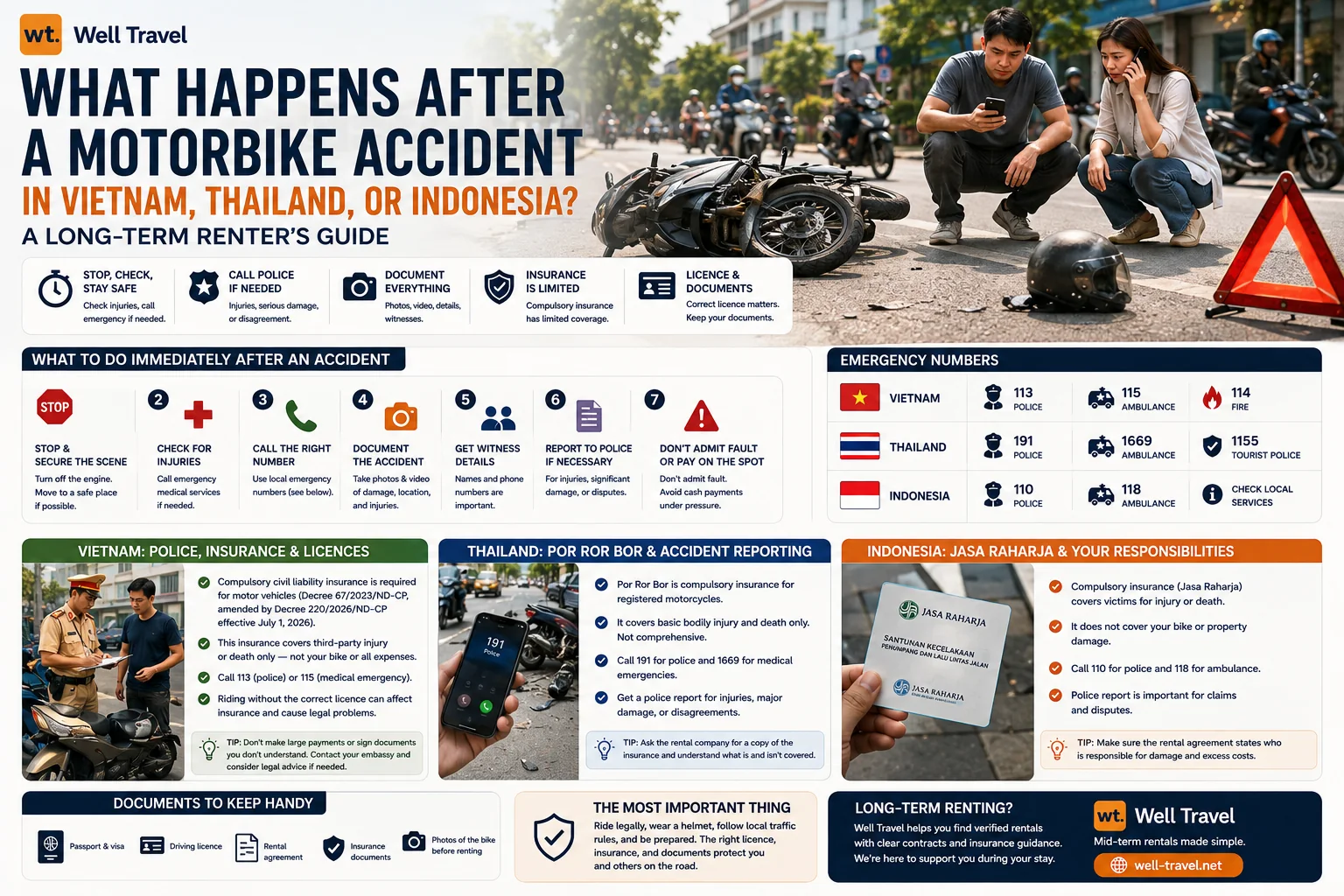
Stop immediately, turn off the engine, and check for injuries. Call emergency services if needed. Stay at the scene, document what happened, exchange details, and don't admit fault before you know the full picture.
If there are injuries, significant damage, or a disagreement, call the police and get an official report. That report can be critical for insurance and liability.
Compulsory insurance in Vietnam, Thailand, and Indonesia covers only specific risks. It is not comprehensive cover for your rental bike, your medical costs, or every claim against you.
For long-term renters, the most important protection starts before the ride: correct licence, appropriate insurance, a clear rental agreement, and photo evidence of the bike's condition.
What to do immediately after a motorbike accident
1. Stop and secure the scene
Don't ride away, even after a minor scrape. Turn off the engine, and if it's safe, move yourself and the bike away from traffic.
Don't move an injured person unless there's immediate danger.
2. Check for injuries
If someone is seriously injured, unconscious, bleeding heavily, or in severe pain, call emergency medical services.
If a rider is wearing a helmet and may have a head or neck injury, avoid removing the helmet unless you must do so to give emergency care.
3. Call the right emergency number
Save these before you ride:
| Country | Police | Ambulance / medical emergency | Additional help |
|---|---|---|---|
| Vietnam | 113 | 115 | 114 (fire) |
| Thailand | 191 | 1669 | 1155 (Tourist Police) |
| Indonesia | 110 | 118 | Check local services for the area |
Thailand's government also lists 191 for emergencies, 1669 for medical help, and 1155 for Tourist Police. In Vietnam, 113 is police and 115 is medical.
4. Don't admit fault at the scene
Be polite and cooperative, but don't say 'It was all my fault' before the facts are clear. Even a casual apology can be interpreted differently in a dispute. Stick to describing what happened.
5. Document the accident
Take photos and video of:
- both bikes and licence plates;
- visible damage;
- vehicle positions;
- road markings, signs, and conditions;
- visible injuries;
- skid marks or debris;
- the rental bike before it's moved, if safe.
Record the date, time, and location too.
6. Collect witness details
If anyone saw the accident, get their names and phone numbers. Independent witnesses matter when the parties disagree.
7. Report serious accidents to the police
If someone is injured, property is badly damaged, or the parties don't agree, contact the police and ask how to file an official report. Keep a copy of any paperwork.
8. Don't make a large payment under pressure
Don't hand over cash or sign a settlement just because someone is demanding immediate payment. If a genuine settlement is agreed, document the amount, reason, date, and identities. For significant claims, talk to your insurer or a local lawyer first.
Vietnam: police, insurance, and driving licences
In Vietnam, traffic police are called Cảnh sát giao thông. Call 113 for police help and 115 for medical emergencies.
Vietnam requires compulsory civil liability insurance for motor vehicle owners. The current framework is based on Decree 67/2023/ND-CP, with changes under Decree 220/2026/ND-CP effective from July 1, 2026.
This compulsory insurance covers the owner's civil liability to third parties. It is not comprehensive insurance for your own bike, and it is not a guarantee that your medical or other expenses will be covered.
Keep all police and insurance documents. The exact compensation and claim process depends on the circumstances, the policy, and current regulations.
Your driving licence matters
Don't assume your home-country licence lets you ride in Vietnam. Licence requirements depend on the motorcycle type and your situation. If you'll be riding for months, check Vietnam's current requirements before you rent.
Riding without the legally required licence can cause problems after an accident, including with insurance claims.
What to avoid in Vietnam
Don't make a large payment to another party or their relatives immediately after a crash without understanding what you're agreeing to.
Don't sign Vietnamese-language documents you don't understand. Ask for a translation or qualified help first.
If you're detained or the accident is serious, contact your embassy or consulate and consider local legal advice.
Thailand: Por Ror Bor and accident reporting
Thailand requires registered motorcycles to have compulsory motor insurance called Por Ror Bor, under the Motor Vehicle Victims Protection Act.
Por Ror Bor covers basic bodily injury and death from road accidents. It does not provide comprehensive cover for motorcycle damage or every financial loss.
This matters when renting: valid Por Ror Bor on the bike does not mean damage to the rental motorcycle is covered, or that all your expenses will be paid.
Ask the rental company what additional voluntary insurance, if any, covers the bike and the renter.
Police and Tourist Police
- 191 – emergency police
- 1669 – emergency medical
- 1155 – Tourist Police
If the accident involves injuries, serious damage, or a dispute, call the police and keep the documentation. If asked to sign documents at a police station, make sure you understand them. If you don't understand Thai, ask for an explanation or translation first.
Your driving licence matters in Thailand
Check the exact licence requirements for your nationality and motorcycle category before riding. Your ordinary home-country licence may not be enough; an international driving permit or Thai licence may be required.
Riding without the correct licence can also complicate insurance claims.
Indonesia and Bali: Jasa Raharja and rental insurance
Indonesia runs a state accident compensation system called Jasa Raharja.
Under Law No. 34 of 1964, Jasa Raharja provides third-party protection for people outside the vehicle responsible for an accident, plus passenger protection under Law No. 33 of 1964.
This is a statutory compensation system, not a substitute for comprehensive travel or motorcycle insurance. It may not cover all medical expenses, bike damage, lost income, or other losses.
Motorcycle rental contracts matter
Before you ride, read the rental agreement carefully. Pay attention to:
- responsibility for damage to the motorcycle;
- excess or deductible amounts;
- theft and total-loss provisions;
- whether a second rider is allowed;
- what happens after an accident;
- insurance exclusions;
- driving licence requirements.
Take photos and video of the bike before riding, including bodywork, mirrors, lights, tyres, dashboard, and odometer. Keep the originals rather than relying on images sent through messaging apps.
Driving licences in Indonesia
Don't assume your national licence is enough to ride in Indonesia. Requirements depend on your nationality and circumstances.
For example, current UK government guidance says a UK licence alone cannot be used in Indonesia; an International Driving Permit can be used, while UK nationals living in Indonesia with a KITAS may apply for an Indonesian licence.
The same principle applies broadly: check the rules for your country and motorcycle category before you ride.
Compulsory insurance is not the same as full insurance
A common misunderstanding is that a motorcycle with compulsory insurance is fully insured. It is not.
Each country has a different legal system and insurance arrangement, but the basic point is the same:
Compulsory cover provides legally required protection for certain people affected by road accidents. It does not automatically mean damage to your rental bike is covered, all medical expenses are covered, all claims against you are covered, lost income is covered, or your travel insurer will pay.
Voluntary motorcycle insurance may exist through the rental company. Ask exactly what it covers and, just as importantly, what it excludes.
Travel insurance may help, but motorcycle cover is often conditional. Check whether your policy covers motorcycle accidents, engine size, the country, your licence type, whether an IDP is required, helmet use, and alcohol or drug exclusions.
Never assume that having travel insurance means every motorcycle accident is covered.
Your driving licence can affect your insurance
The right licence is not a formality. If local law requires a particular licence or IDP and you don't have it, you may face penalties and problems with insurance claims.
Requirements differ across Vietnam, Thailand, and Indonesia, so check the rules for your nationality and motorcycle category before renting.
A valid licence also doesn't determine fault in an accident. It simply means you're complying with basic legal requirements for riding.
A practical pre-ride checklist for long-term renters
Buy or use a proper helmet
Make sure it fits and is in good condition. Don't assume every rental helmet gives the same protection.
Inspect the motorcycle in daylight
Check brakes, tyres, lights, mirrors, horn, indicators, and visible damage. If something feels unsafe, ask for another bike.
Photograph the motorcycle
Before leaving the rental shop, photograph and video the whole bike, especially existing scratches, dents, mirrors, lights, and other vulnerable parts.
Keep your documents accessible
Keep copies of your passport, visa, driving licence, IDP if required, travel insurance policy, rental agreement, and emergency contacts. Store digital copies offline too.
Save emergency numbers
Save the relevant police and medical numbers before you ride.
Never ride under the influence
Don't ride after drinking alcohol or taking anything that impairs you. Apart from safety, impairment creates serious legal and insurance consequences.
What if you are taken to a police station?
Stay calm and cooperate. Ask what is happening, and request an interpreter or translation before signing anything you don't understand.
If the accident involves serious injury, death, significant damage, or a possible criminal investigation, seek local legal advice.
You can also contact your embassy or consulate. They generally can't pay fines or settle private claims, but they can help with information about local legal assistance.
Don't sign an admission of liability or a major settlement just because you feel pressured to resolve things quickly.
What long-term renters should remember
A motorcycle can be one of the most convenient ways to get around Southeast Asia, especially for a multi-month stay. But more time on the road means more exposure to unfamiliar traffic, weather, and road conditions.
Before riding, make sure you have:
1. The correct driving licence. Check the rules for your nationality and motorcycle category.
2. Appropriate insurance. Don't confuse compulsory vehicle insurance with comprehensive motorcycle or personal coverage.
3. A clear rental agreement. Understand who is responsible for damage, theft, deductibles, and accident-related costs.
4. Evidence of the motorcycle's condition. Take photos and video before your first ride.
5. Emergency contacts. Know how to reach police and medical services in the country where you're riding.
And if an accident happens: stay at the scene, get medical help when needed, document what happened, and avoid large payments or important documents under pressure.
The bottom line
The best way to handle a motorbike accident is to prepare before it happens.
For long-term renters in Vietnam, Thailand, and Indonesia, that means checking your licence requirements, understanding the insurance attached to the bike, reading the rental agreement, and documenting the motorcycle before you ride.
Compulsory insurance provides important protection, but it is not a replacement for appropriate personal, travel, or motorcycle insurance.
If an accident happens: stop, stay calm, get help, document everything, and don't agree to major financial or legal commitments before you understand what you're signing.
This article is for general educational purposes only and is not legal advice. Traffic, licensing, and insurance regulations can change, and the rules applicable to you may depend on your nationality, motorcycle category, insurance policy, and individual circumstances. Always confirm current requirements with local authorities, your insurer, or a qualified local lawyer.
Well Travel supports long-term renters with 1–12 month accommodation in Vietnam, Thailand, and Indonesia, including bilingual electronic contracts and deposit protection. Well Travel does not provide legal advice or motorcycle insurance.