Things to Do in Phuket: Best Beaches, Islands, Temples, and Markets — 2026 Guide
Looking for a place in Phuket, Thailand? Tell us what you need and we’ll look for matching options.
Request a home searchPhuket is easy to underestimate. Most people arrive for the beaches, but after a few days it becomes clear that the island is much more than a stretch of sand and a hotel pool.
You can spend a morning swimming at Kata, eat Hokkien noodles in Old Phuket Town, visit a Buddhist temple in the afternoon, and finish the day watching the sun go down over the Andaman Sea. On another day, you can leave early for Phi Phi, Phang Nga Bay, or one of the smaller islands nearby.
This guide covers the best things to do in Phuket in 2026, including the beaches worth visiting, island trips, temples, viewpoints, markets, food, and a few practical details that can make your trip much easier.
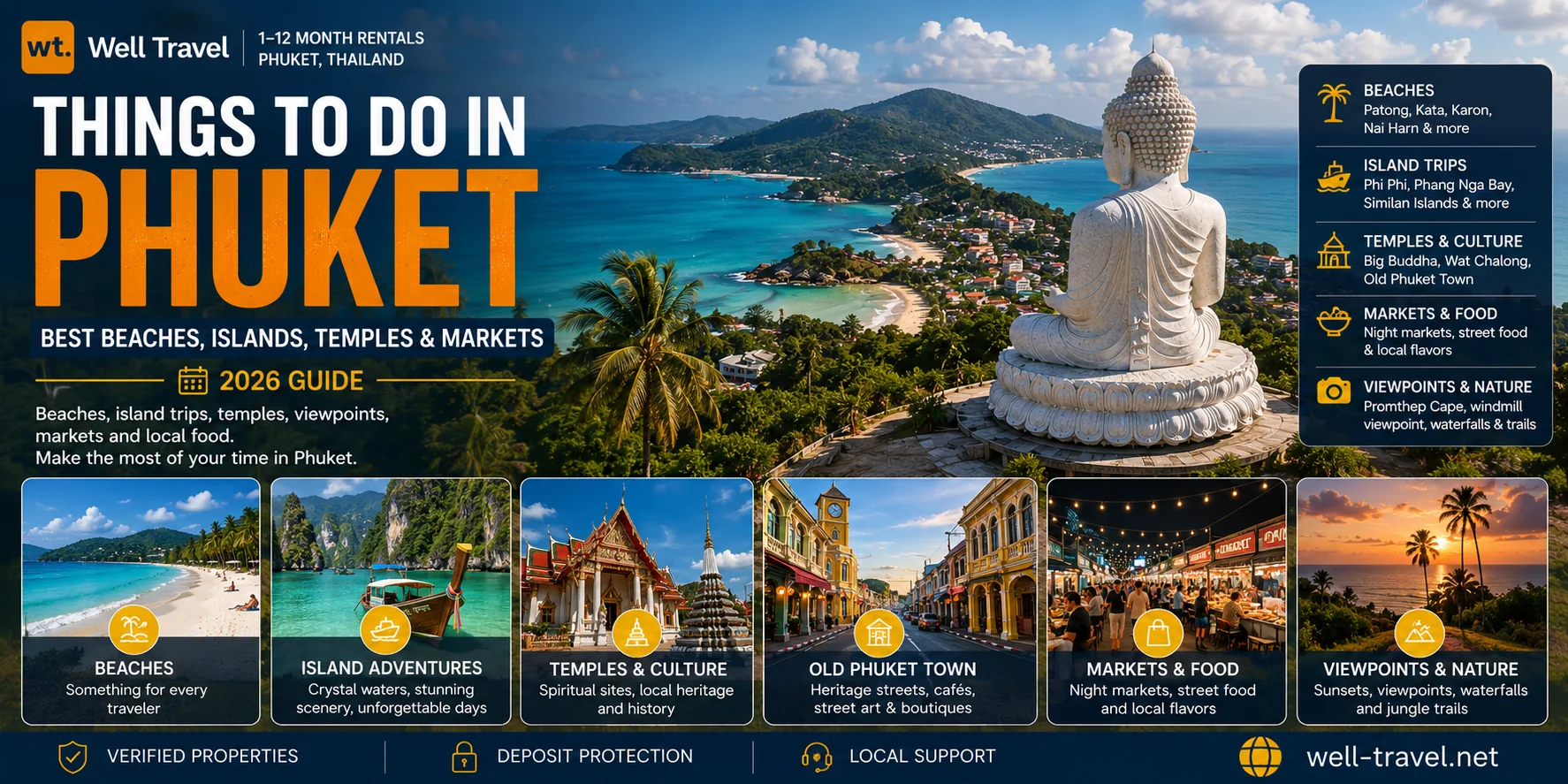
Phuket at a Glance
Phuket is Thailand's largest island and one of the country's most popular destinations. The west coast is lined with beaches and resort areas, while Phuket Old Town has a very different atmosphere, with historic shophouses, cafés, restaurants, markets, and street art.
The island is also a convenient base for exploring the surrounding Andaman Sea. Phi Phi, Phang Nga Bay, Koh Hae, Koh Racha, and the Similan Islands can all be reached on organized trips from Phuket.
One thing to keep in mind: these places are not all on Phuket itself. Some of the most popular "Phuket day trips" actually take you into neighboring Phang Nga or Krabi provinces.
1. Explore Phuket's Beaches
Phuket has beaches for almost every type of trip, and choosing the right one matters more than it might seem.
Patong Beach is the busiest and most developed. It has everything close by — restaurants, shops, hotels, water sports, and nightlife. If you want to be able to walk out of your hotel and straight into the action, Patong is hard to beat.
Kata Beach and Karon Beach are easier choices if you want a beach holiday without the constant buzz of Patong. Both have plenty of restaurants and accommodation nearby and are popular with families and couples.
Nai Harn Beach, in the south, feels greener and less built-up. A lagoon sits directly behind the beach, and the surrounding hills make the area feel quite different from central Patong.
Kamala Beach is another popular alternative to Patong, with a more relaxed atmosphere. Surin Beach is scenic and has a more natural feel than many of the island's busier beaches. In 2026, it also has far less commercial activity directly on the sand than older Phuket guides often show, so don't expect rows of beach restaurants and vendors.
Rawai Beach is different again. It is not the best place on the island for swimming, but it is an important departure point for long-tail boat trips to Koh Hae and other islands around southern Phuket.
Phuket's official tourism information lists Patong, Kata, Karon, Rawai, Kamala, Surin, Nai Harn, and several other beaches among the island's main coastal destinations.
What about surfing?
Phuket has a seasonal surf scene rather than year-round waves.
During the southwest monsoon, roughly from May through October, the west coast can get enough swell for surfing. Kata Beach is the island's best-known surf spot, while Kalim and Kamala can also have suitable conditions.
Surf schools and board rentals operate during the season, but the conditions can change quickly. If you see a red flag on the beach, take it seriously — the waves and currents can become dangerous even when the water looks inviting.
2. Take a Boat Trip to the Islands
One of the best things about staying in Phuket is how many places you can reach by boat.
You don't have to spend every day on the same beach. Depending on the season and the weather, you can head to limestone islands, snorkeling spots, quiet beaches, or sea caves.
Phi Phi Islands
The Phi Phi Islands are famous for their steep limestone cliffs, clear water, and tropical beaches. They are one of the classic day trips from Phuket, and there is a reason they remain popular.
Most excursions use speedboats or larger tour boats. The exact journey time depends on the boat and itinerary, and tours usually combine several stops rather than taking you to just one island.
If you want a full day on the water, Phi Phi is one of the easiest choices.
Maya Bay
Maya Bay, on Phi Phi Leh, became famous after appearing in The Beach. It is part of Hat Noppharat Thara–Mu Ko Phi Phi National Park and is managed with strict conservation measures.
For 2026, Maya Bay is closed from August 1 through September 30 for its annual environmental recovery period. During this time, visitors cannot enter the bay, although boats can still visit other parts of the Phi Phi area.
The bay is expected to reopen on October 1, 2026, subject to official conditions. Even when it is open, access, swimming, landing, and visitor numbers can be restricted.
If seeing Maya Bay is one of the main reasons for your trip, check the latest national park information before booking a tour. It is better than discovering on the pier that the day's itinerary has changed.
Phang Nga Bay
Phang Nga Bay is in neighboring Phang Nga Province, not on Phuket itself, but it is one of the island's most popular day trips.
The landscape is completely different from Phuket's beaches: huge limestone karsts rise out of the water, with sea caves, mangroves, and narrow channels between the islands.
Most tours include James Bond Island, and many also stop at Koh Panyee, a Muslim fishing village built partly over the water.
Choose Phang Nga Bay if you want scenery and kayaking rather than spending the whole day swimming.
Similan Islands
The Similan Islands are one of Thailand's best-known destinations for diving and snorkeling.
They are part of a protected national park and are open only during the seasonal operating period. For the 2026–2027 season, the islands are scheduled to be open from October 15, 2026, through May 15, 2027.
A Similan trip is not a quick island hop. From Phuket, you normally need an early transfer to a pier in Phang Nga and then a boat journey. In practice, this means a long day with an early start.
It is worth it for serious divers and people who specifically want the Similans, but if you simply want a relaxed day at sea, Koh Hae or Koh Racha is much easier.
Koh Racha and Koh Hae
For a shorter island day, look at Koh Racha or Koh Hae (Coral Island).
Both are close to Phuket and are popular for swimming, snorkeling, and spending a few hours on the beach without committing to a very early start and a full day of transfers.
3. Visit Big Buddha and Wat Chalong
Two of Phuket's best-known religious landmarks are close enough to visit on the same day.
Big Buddha
The Big Buddha of Phuket, officially known as Phra Phuttha Ming Mongkol Akenakiri, stands on Nakkerd Hill between Chalong and Kata. The white statue is about 45 meters tall and overlooks southern Phuket.
There is an important 2026 update: after the site was closed following the August 2024 landslide in the area, the Big Buddha reopened to visitors on March 3, 2026.
Because the site was affected by the landslide and subsequent safety work, access can still be subject to local conditions. Check current information before making the trip up the hill.
Entry is free, although donations are welcome. This is a religious site, not simply a viewpoint, so dress accordingly: cover your shoulders and knees and remove your shoes where required.
Wat Chalong
Wat Chalong, also known as Wat Chai Tharam, is one of the island's best-known temples and an active place of worship.
It is closely associated with Luang Por Chaem, a highly respected monk in Phuket's history. Both local residents and visitors come to pay their respects here.
Wat Chalong works well as part of a southern Phuket sightseeing route, especially if you are already visiting Big Buddha and the viewpoints around Kata and Nai Harn.
4. Wander Around Phuket Old Town
If the beaches start to feel a little too similar, head to Phuket Old Town.
The historic center grew during Phuket's tin-mining era and was shaped by communities from China, India, Europe, and elsewhere who came to the island to trade and settle.
Today, the area is known for colorful Sino-Portuguese and Sino-European shophouses, cafés, restaurants, museums, old mansions, and street art.
Thalang Road is the obvious place to start, but don't stop at the main street. Some of the best parts of Old Town are the smaller streets nearby, where you can find old façades, small cafés, local food shops, and much less traffic.
The historic character of the area and its multicultural background are also highlighted by Thailand's tourism authorities.
Sunday Walking Street
On Sunday afternoons and evenings, Thalang Road becomes the Lard Yai Sunday Walking Street Market.
The market runs roughly from 4:00 PM to 10:00 PM and is a good place to try local snacks, browse handicrafts, and see the Old Town when the streets become much livelier.
If you have never been to Phuket before, this is one of the easiest ways to see something that has nothing to do with resorts or beaches.
5. Watch the Sunset From a Viewpoint
Phuket faces west, so sunsets are one of the easiest free things to add to your itinerary.
Promthep Cape
Promthep Cape at the southern tip of Phuket is probably the island's most famous sunset viewpoint.
The views stretch over the Andaman Sea and nearby islands, and the place gets busy as sunset approaches. Arrive early if you want a good spot rather than squeezing in at the last minute.
Karon Viewpoint
Karon Viewpoint sits between Kata and Nai Harn and looks across three bays: Kata Noi, Kata, and Karon.
It is a quick stop, but one of the more worthwhile ones if you are already driving around southern Phuket.
Samet Nangshe
Samet Nangshe is not on Phuket. It is in Phang Nga Province, across the bridge from the island.
The viewpoint looks over the limestone islands of Phang Nga Bay and is particularly impressive at sunrise.
If you want to see it properly, expect an early start. This is not the kind of place you casually add after dinner.
6. Eat Your Way Through Phuket's Markets
Phuket's food culture has strong Chinese influences, so there is more to eat here than the standard pad thai and green curry.
Try local specialties such as:
- Hokkien mee — stir-fried noodles associated with Phuket's Chinese heritage
- Crab curry — a rich local seafood dish
- Kuay jap — peppery soup with rolled rice noodles
- Pineapple fried rice — a familiar Thai dish that is easy to find around the island
For the best introduction to local food, spend some time around Phuket Old Town. This is where the island's food history is easiest to see rather than just ordering the same dishes you would find anywhere else in Thailand.
For a more casual evening, Chillva Market, Naka Market, and the food markets around Patong offer plenty of inexpensive options.
One simple rule for street food: go where people are actually eating. A busy stall with a steady turnover is usually a safer bet than an empty one with a huge menu.
7. Visit an Ethical Elephant Sanctuary
If you want to see elephants during your trip, choose the experience carefully.
Look for places where elephants are allowed to behave naturally and where visitors observe rather than control the animals. Avoid riding, performances, and activities that force elephants to interact with tourists.
A responsible facility should provide adequate space, appropriate food, veterinary care, and proper long-term care.
And don't judge an elephant experience by one activity alone. Water, feeding, or close observation are not automatically unethical; the important question is whether the animal is being forced to perform or interact for entertainment.
8. Go Diving, Snorkeling, or Kayaking
You don't have to be an experienced diver to enjoy Phuket's waters.
Dive centers around Chalong and Kata offer beginner sessions, certification courses, and trips for experienced divers.
For an easy day on the water, consider Koh Hae, Koh Racha, or Phi Phi.
For something more focused on scenery, choose Phang Nga Bay. Kayaking through limestone formations, caves, and mangrove areas is one of the most memorable ways to see the bay.
Experienced divers may want to save a day for the Similan Islands, but keep the seasonal closure in mind when planning your trip.
Practical Tips for Visiting Phuket in 2026
When is the best time to visit Phuket?
For classic beach weather, November through March is generally the most comfortable period, with drier conditions and calmer seas more common.
From roughly May through October, the southwest monsoon brings more rain and stronger waves to the west coast.
That does not mean the wet season is a washout. You can still get long sunny periods, and the island is greener and often quieter outside the peak season.
If swimming is your priority, always pay attention to beach flags rather than relying only on the calendar. Conditions can change quickly.
How do you get around Phuket?
Grab and Bolt are widely used for ride-hailing, alongside taxis and local transport.
If a taxi does not use a meter, agree on the fare before getting in.
Also give yourself more time than Google Maps might suggest during busy periods. Traffic around Patong, Phuket Town, and Chalong can be slow, especially around morning and evening rush hours.
Should you rent a motorbike?
Motorbikes are everywhere in Phuket, but that does not mean everyone should rent one.
Only ride if you are legally licensed for the motorcycle you are using, have the required documentation, and are comfortable riding in unfamiliar traffic.
Phuket has steep hills, sharp bends, busy roads, and plenty of inexperienced tourists on scooters. If you are not confident on a motorcycle, a taxi or ride-hailing app is the better option.
What about national park fees?
National and marine parks may charge entrance fees, with different rates sometimes applying to Thai and foreign visitors.
Fees, closures, visitor limits, and operating rules can change, especially for marine destinations. Check the latest information from the relevant national park or Thai authority before your trip.
What should you wear to temples?
Cover your shoulders and knees when visiting Buddhist temples.
You may also need to remove your shoes before entering certain buildings or religious areas.
It is worth carrying something light that you can throw over your shoulders if you are spending the day in beach clothes.
What sunscreen should you use?
If you plan to snorkel or visit a marine national park, choose a sunscreen that complies with local environmental rules.
Thailand restricts certain sunscreen ingredients considered harmful to coral in protected marine areas. Requirements can vary by destination, so check the rules of the specific park you are visiting.
What to Do in Phuket If You Only Have One Day
If you have just one day, don't try to cover the whole island. You will spend more time in traffic than actually seeing anything.
For a first visit, a good route is:
Phuket Old Town → Wat Chalong → Big Buddha → Karon Viewpoint → Promthep Cape
It gives you a mix of history, local culture, temples, and some of the island's best-known views. This combination is also broadly reflected in the Tourism Authority of Thailand's recommended one-day Phuket route.
If beaches and islands are your main priority, do the opposite: skip the sightseeing circuit and spend the day on the water.
Final Thoughts
Phuket can be as busy or as relaxed as you want it to be.
You can spend your whole holiday between Patong and the beach, or you can get up early for an island trip, eat your way through Old Town, stop at a temple, and finish the evening watching the sunset from the south of the island.
If you only have a few days, don't try to collect attractions like souvenirs. Pick a couple of areas and actually enjoy them.
And if you're staying for a few weeks or longer, that's when Phuket gets much more interesting. Move beyond the main tourist areas, try different beaches, visit local markets, and give yourself time to discover the quieter parts of the island.
That's where the real Phuket starts to show up.