Cost of Living in Phuket in 2026: A Complete Budget Guide for Long-Term Renters
Looking for a place in Phuket, Thailand? Tell us what you need and we’ll look for matching options.
Request a home searchPhuket is one of Thailand’s top spots for long-term stays — digital nomads, retirees, and remote workers love it here. But the cost of living? It’s easy to misjudge. Your monthly budget really depends on your lifestyle, where you stay, and how you handle daily expenses. This guide breaks down the real costs of renting a place for 1 to 12 months in Phuket, with prices updated for 2026.
Accommodation: Your Biggest Cost
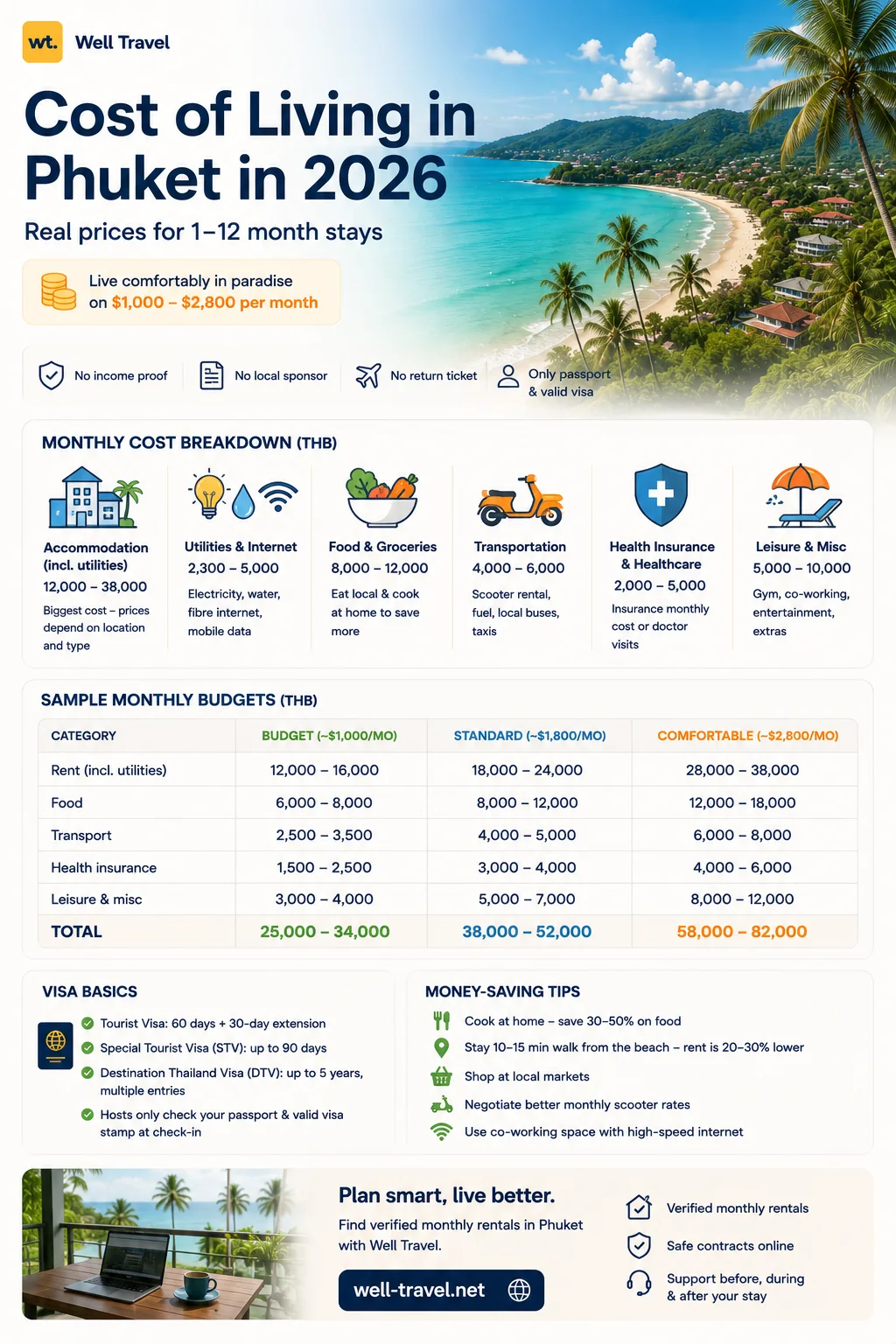
Rent is where most of your money goes, and prices have climbed in recent years. In central areas like Patong, Kata, or Karon, a studio condo runs 15,000–25,000 THB per month ($420–$700 USD), while a one-bedroom apartment costs 20,000–35,000 THB. Want to save? A basic room further from the beach can be 10,000–15,000 THB. Booking through a platform like Well Travel for month-long stays often gets you better rates than nightly deals. Just make sure utilities (electricity, water, internet) are either included or clearly metered.
What Hosts Ask at Check-In
When you book long-term through our marketplace, hosts only need to see your passport and current visa stamps to confirm you’re in Thailand legally. No off-platform contracts, no proof of income, no return tickets, no local sponsors needed. The contract? Signed online and stored in the system. As long as your visa is valid at move-in, the host will confirm your booking.
Utilities and Internet
Electricity in Phuket isn’t as cheap as you’d think. A one-bedroom apartment typically costs 1,500–3,500 THB per month, depending on how much you run the AC. Water is usually 200–500 THB. Fibre internet runs 600–1,000 THB, and many rentals include it. Mobile data plans from AIS, TrueMove, or dtac cost 400–800 THB for plenty of data.
Food and Groceries
Eating out is affordable if you stick to local spots. A meal at a Thai restaurant or street stall costs 50–100 THB. Western places charge 200–400 THB per dish. Cooking at home? Groceries from markets or supermarkets (Makro, Big C, Lotus’s) run about 3,000–6,000 THB per month for one person. All in, expect to spend 8,000–12,000 THB monthly on food.
Transportation
Most long-term residents rent a scooter for 2,500–4,500 THB per month. Fuel adds 1,000–1,500 THB if you use it daily. Taxis and tuk-tuks are pricey for short trips (200–400 THB per ride), so a scooter is pretty much essential for saving cash. Alternatively, hop on a local Songthaew bus between beaches — 20–40 THB per ride. A monthly transport budget of 4,000–6,000 THB is realistic.
Health Insurance and Healthcare
Health insurance isn’t required for short-term tourists, but it’s smart for long stays. A good international plan covering outpatient and inpatient care costs 2,000–5,000 THB per month, depending on your age and coverage. Without insurance, a doctor visit runs 500–1,000 THB, but hospital stays can get expensive. Some long-stay visas (like the O-A) even require mandatory insurance. Digital nomads on tourist visas usually go with travel insurance or a local Thai plan.
Leisure and Miscellaneous
Phuket has plenty of free stuff (beaches, hiking), but you’ll probably spend on gym memberships (1,500–3,000 THB/month), yoga classes, co-working spaces (3,000–6,000 THB/month), and the occasional night out. Budget 5,000–10,000 THB per month for extras.
Visa and Legal Basics
For stays longer than 60 days, you’ll need a valid visa. Most digital nomads use a Tourist Visa (60 days + 30-day extension) or the Special Tourist Visa. Thailand also introduced the Destination Thailand Visa (DTV) for remote workers and freelancers — good for up to 5 years with multiple entries. Always have a valid visa stamp when checking in with your host. Working for a Thai employer without a work permit is illegal, but remote work for a foreign company is generally fine for short stays. Tax-wise, if you stay over 180 days in a year, you may become a tax resident — though enforcement for digital nomads is light. No local sponsor needed to rent.
Sample Monthly Budgets (in THB)
| Category | Budget (~$1,000/month) | Standard (~$1,800/month) | Comfortable (~$2,800/month) |
|---|---|---|---|
| Rent (incl. utilities) | 12,000–16,000 | 18,000–24,000 | 28,000–38,000 |
| Food | 6,000–8,000 | 8,000–12,000 | 12,000–18,000 |
| Transport | 2,500–3,500 | 4,000–5,000 | 6,000–8,000 |
| Health insurance | 1,500–2,500 | 3,000–4,000 | 4,000–6,000 |
| Leisure & misc | 3,000–4,000 | 5,000–7,000 | 8,000–12,000 |
| Total | 25,000–34,000 | 38,000–52,000 | 58,000–82,000 |
These are estimates based on mid-2026 market conditions. Your actual costs will vary depending on how often you eat out, your location, and whether you avoid pricey activities.
Money-Saving Tips for Phuket
- Rent a place with a kitchen — cooking at home cuts food costs by 30–50%.
- Choose a spot a 10–15 minute walk from the beach instead of beachfront; rent can drop by 20–30%.
- Shop at local markets for fresh produce, skip 7-Eleven for everyday groceries.
- Negotiate a better monthly rate for scooter rentals.
- Join a co-working space with high-speed internet to avoid paying for a separate home plan.
Final Thoughts
Phuket is still affordable compared to Western Europe, North America, or even other Asian capitals — though prices have crept up. With some planning, you can live comfortably on $1,500–$2,000 per month. The trick is getting the right visa and locking in a well-priced monthly rental through a platform that handles contracts properly. Remember, hosts in Phuket only care about your visa status — as long as you’re here legally, you’re all set for a stress-free stay.