Phuket Beyond the Beaches: Best Things to See and Do — 2026 Guide
Looking for a place in Phuket, Thailand? Tell us what you need and we’ll look for matching options.
Request a home searchMost Phuket itineraries begin and end at the water. But the island’s most distinctive sights — Chinese shrine rooftops, Sino-Portuguese shutters, rainforest greens — sit inland. If you can spare a day or two from the sunbed, spend it on the Phuket behind the beach. Since most popular guides already cover the beaches and island-hopping trips, this list intentionally leaves those out.
Start With a Slow Morning in Old Phuket Town
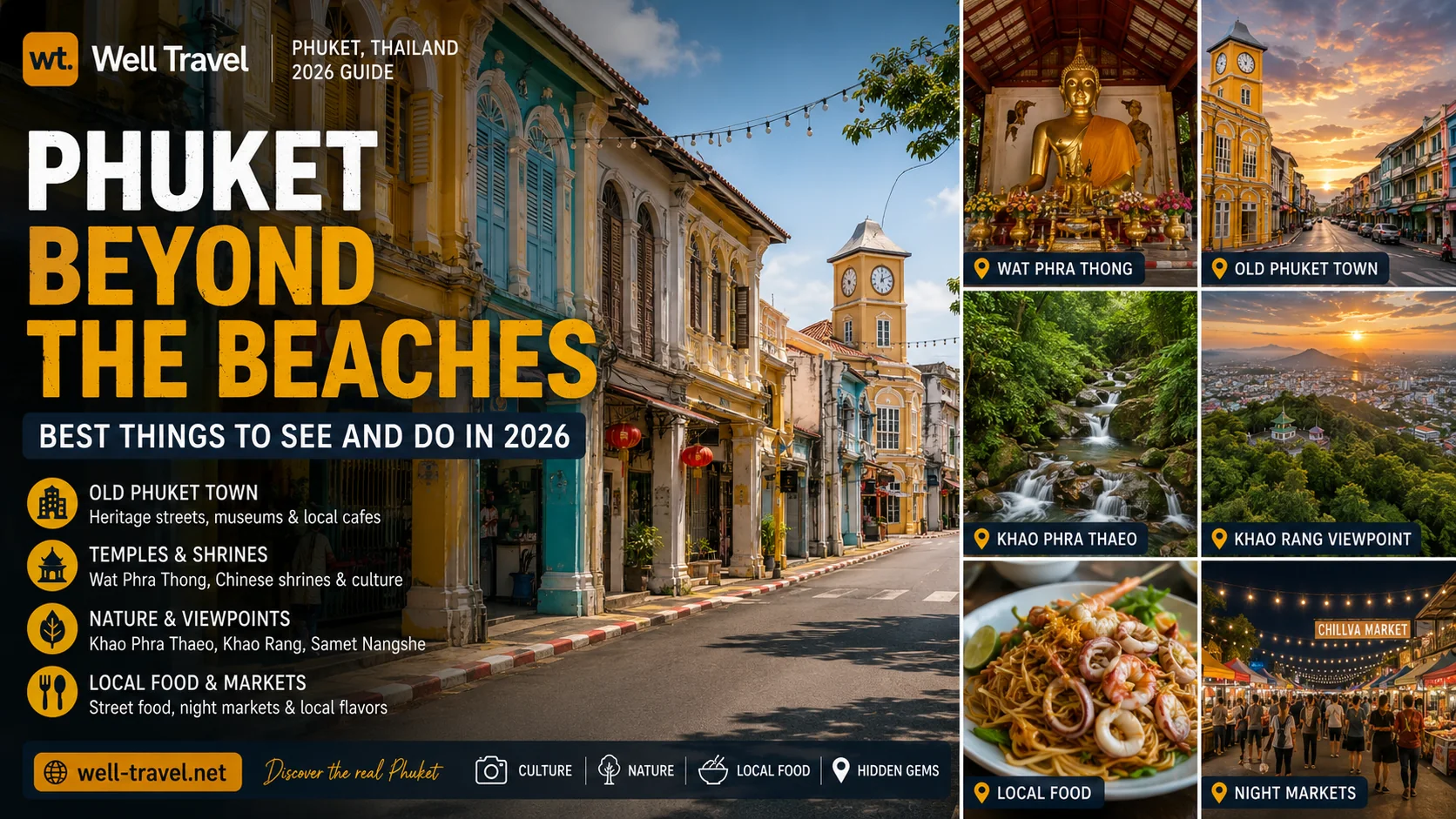
Old Phuket Town is the best one-stop place to discover Phuket beyond the beaches. Thalang Road is the busiest stretch, lined with restored shophouses painted in pastel colors. Wander down Soi Romanee for a quieter lane of old wooden buildings, then continue to Krabi Road for Chinese clan associations and former merchant mansions. The Phuket Thai Hua Museum, in a handsome Sino-Portuguese building, explains the tin-mining boom and the island’s Peranakan Chinese culture; it’s small, so an hour is enough.
For empty streets and cooler air, visit in the morning. Come on Sunday for the Walking Street market, when Thalang Road fills with food stalls from mid-afternoon until late evening. On weekdays, the architecture is the main event and you can take photos without a crowd.
Go Beyond Wat Chalong and the Big Buddha
Most visitors who want a temple day in Phuket are sent to Wat Chalong and the Big Buddha. They are worth seeing, but for Phuket’s older local life, head north instead to Wat Phra Thong in Thalang District. This is a working temple built around a partially exposed golden Buddha image. Local stories say attempts to dig out the statue were abandoned after misfortune, so only the upper half is visible today. You can enter the shelter, walk around the grounds, and usually have the place to yourself outside major holidays.
Back in Phuket Town, the Chinese shrines reveal another layer of Phuket history. Jui Tui Shrine and Bang Niew Shrine are two of the most important centers for the Vegetarian Festival, which runs for nine days during the ninth Chinese lunar month, usually around September or October. Outside festival time, they are quiet places of incense and red lanterns. If your trip coincides with the 2026 festival, expect processions, drums, firewalking, and serious crowds. Watch from behind barriers and never block a procession — this is a ritual, not a reenactment.
Walk Into the Rainforest at Khao Phra Thaeo
Khao Phra Thaeo Wildlife Sanctuary protects part of Phuket’s remaining rainforest in the northeast of the island. It is not a flat nature park; paths are uneven and slippery after rain. The easiest goal is Bang Pae Waterfall, a short walk from the parking area. A little farther on, the Gibbon Rehabilitation Project cares for gibbons rescued from the illegal pet trade. It is an education center, not a photo stop, and relies on visitor donations.
If you want a longer walk, continue to Ton Sai Waterfall. The trail is still short by mountain standards but more of a workout than Bang Pae. Take water, insect repellent, and cash for the entrance fee, and go early or late afternoon to avoid the heat.
Get a Different Island View From a Hill
Promthep Cape isn’t Phuket’s only great viewpoint. For a low-effort panorama in the center of Phuket Town, Khao Rang (Rang Hill) has a public summit, a few food stalls, and a fitness path. Locals favor it at sunset; from the top, Phuket Town spreads out below while the coast glows in the distance.
The bigger photographic payoff is Samet Nangshe, technically in Phang Nga province across the Sarasin Bridge. The viewpoint sits on a green ridge looking over Phang Nga Bay’s limestone karsts. It is about an hour’s drive from Phuket Town and best at sunrise, when the bay is still misty. Bring small cash for the viewpoint fee and expect a short uphill walk. This is the kind of trip you do with a car or an experienced motorbike rider, not as an afterthought.
Eat Where Phuket Eats During the Day
Beyond the beach-restaurant strip, Phuket eating follows the local day. Start with morning dim sum and locally brewed kopi in Phuket Town. For lunch, follow the crowd at a khao kaeng rice-and-curry stall; many sell out by early afternoon. For dinner, look for Phuket signatures such as mee Hokkien — yellow Hokkien noodles tossed with pork, squid, and soy — and moo hong, slow-braised pork belly with soy and spices.
For a sit-down version, Raya and One Chun are Phuket Town’s best-known restored-house restaurants serving this style. For something more casual, wait until evening and head to a market. Chillva Market runs most evenings, Naka Market’s food section is best on weekends, and Sunday Walking Street in Old Phuket Town is a full street-food loop.
How To Turn These Into a Route
If you only have one non-beach day, combine them. Start in Old Phuket Town, visit a Chinese shrine or the Thai Hua Museum, eat a local lunch, drive up to Khao Rang for the view, then end with an evening market.
If you have a second day, make it a northern loop: Wat Phra Thong in the morning, then Khao Phra Thaeo and Bang Pae. Samet Nangshe works best as an early start if you don’t mind a longer drive and want sunrise over the bay.
Phuket traffic and parking can be messy, so a scooter is often the quickest way around, but only if you already ride. Otherwise, a private car or driver is the better call. Carry cash for small entrance fees and food stalls. Most of these places do not take cards, and that is part of the appeal.